Just Released: Mid-Year Viewpoint 2026
Aug 19, 2026
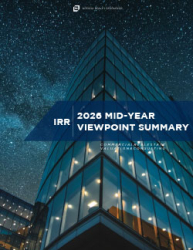
Retail Leads an Uneven U.S. CRE Recovery, IRR Mid-Year Report Finds
More Than 90% of Retail Markets Are in Recovery or Expansion as Office Remains Divided, Multifamily Rebalances and Industrial Normalizes, Based on 220 Local Reports Across 62 U.S. Markets
DENVER, CO, Aug. 19, 2026, The U.S. commercial real estate recovery is following markedly different paths across property sectors and markets, according to Integra Realty Resources’ (IRR) newly released 2026 Mid-Year Viewpoint Report. More than 90% of retail markets surveyed are in recovery or expansion, while office markets remain evenly divided between recovery and recession. Multifamily performance is being shaped largely by local supply cycles, while industrial markets are concentrated primarily in the expansion and hypersupply phases.
Across all four sectors, IRR’s data reveals a continued flight to quality, with modern, well-located and specialized properties outperforming older or commodity-oriented assets. Speculative construction has slowed sharply as lenders, developers and investors become increasingly selective.
“National data provides essential context, but the clearest picture emerges when it is informed by what is happening on the ground,” said Anthony M. Graziano, MAI, CRE, CEO of Integra Realty Resources. “Investors cannot assume that modest rate cuts will meaningfully improve transaction economics, particularly while long-term borrowing costs and equity return requirements remain elevated. Through year-end and into 2027, we expect opportunities to remain concentrated in markets and assets where the basis, income growth and local demand support the investment case.”
IRR’s findings are built from the ground up through more than 220 detailed local reports prepared by valuation professionals based in 62 U.S. markets, then standardized and benchmarked through the firm’s proprietary national technology platform. This combination of local expertise and consistent national methodology enables IRR to identify performance gaps that broader national averages can obscure.
Building on IRR’s annual Viewpoint report released each January, the midyear analysis includes a national summary and provides updated cap rate and discount rate trends, market rents, vacancy rates and cycle positioning across the four major property sectors: office, multifamily, retail and industrial.
WHAT IRR’S LOCAL-MARKET DATA REVEALS
Retail:
- Retail remains the healthiest of the four major property sectors, with more than 90% of surveyed markets in either recovery or expansion. Low vacancy and constrained supply continue to support necessity-based, service-oriented, grocery-anchored and well-located experiential retail. (View IRR’s Market Cycle Charts)
- The South has the broadest expansionary momentum. Vacancy is near or below 4% in Miami, Orlando, Austin, Charlotte, Tampa and Palm Beach, supported by population growth, household formation, tourism and limited available space.
- In the East and Central regions, strong suburban corridors are outperforming downtown locations. Affluent suburban and grocery-anchored centers in the East remain stable to tightening, while office- and tourism-dependent districts in markets such as Chicago continue to experience softer conditions.
- Western performance is similarly divided between strong suburban and infill markets and weaker downtown corridors. Denver, Las Vegas, Phoenix, Orange County, San Jose and Seattle report low vacancy and positive absorption, while Los Angeles has experienced negative absorption and downtown San Francisco and Portland continue to recover from reduced office traffic.
Office:
- Office remains the most challenged and bifurcated of the four major property sectors. Of the 62 markets surveyed by IRR, 26 are in recovery and 26 remain in recession, 41.9% each, with five markets in expansion and five in hypersupply. (View IRR’s Market Cycle Charts)
- In the South, demand for premium space contrasts sharply with persistent weakness in older inventory. Austin vacancy has declined to approximately 15% amid substantial positive net absorption, while Miami continues to benefit from corporate relocations and demand for Class A space. Houston and Orlando, however, remain near 20% vacancy, illustrating dramatically different conditions within the same region.
- In the West, technology demand is creating pockets of recovery. San Francisco, San Jose and Seattle are benefiting from renewed technology and artificial-intelligence leasing, while Los Angeles, Oakland, Portland, Salt Lake City and conventional office properties in San Diego remain more challenged.
- National metrics continue to reflect pressure despite these local bright spots. CBD Class A vacancy increased 86 basis points year over year to 22.08%, even as market rent rose 1.25% to $33.79 per square foot. CBD Class A cap rates declined two basis points to 8.21%.
Multifamily:
- National multifamily demand remains durable, but near-term performance is being shaped more by local supply cycles than by a lack of renter demand. Recovery is the largest market-cycle category, accounting for 33.9% of surveyed markets, followed by hypersupply at 30.6%, expansion at 27.4% and recession at 8.1%. (View IRR’s Market Cycle Charts)
- Central and Eastern markets are generally tighter. Chicago is among the strongest multifamily markets, while Cincinnati, Indianapolis, Minneapolis, Grand Rapids and many Cleveland suburbs continue to report low vacancy, positive absorption and moderate rent growth.
- Many Southern markets are still absorbing recent development. Atlanta, Austin, Dallas, Houston, Miami, Nashville, Charlotte, Tampa and Naples remain supply-pressured, although Austin is recording exceptionally strong absorption and Dallas deliveries and absorption are approaching balance.
- In the West, coastal, supply-constrained markets are generally outperforming inland metros. San Jose, Orange County, San Diego, San Francisco and the East Bay continue to benefit from limited new supply and high barriers to homeownership, while Phoenix, Las Vegas, Portland and Salt Lake City face slower absorption, concessions or flat rents.
Industrial:
- Industrial fundamentals remain healthy by historical standards, but the sector is normalizing after several years of exceptional development and rent growth. Hypersupply is now the largest market-cycle category, accounting for 35.5% of surveyed markets, followed closely by expansion at 33.9%; 17.7% are in recovery and 12.9% are in recession. (View IRR’s Market Cycle Charts)
- In the South, strong demand centers are diverging from markets still absorbing speculative supply. Dallas and Nashville continue to post strong leasing activity, while Orlando, Charlotte and Greenville are showing signs of stabilization. Austin, Houston, Miami, Jacksonville, Tampa, Atlanta and other portions of South Florida carry higher vacancy or slower absorption following heavy development.
- Central markets remain fundamentally sound overall. Chicago, Indianapolis and Cincinnati are generating positive net absorption, while Columbus continues to benefit from data-center and advanced-manufacturing investment.
- The West remains in a post-boom correction. Los Angeles, Orange County, San Diego, San Francisco and San Jose retain long-term advantages from constrained land, ports and advanced-manufacturing demand. Phoenix, Las Vegas, Boise, Seattle, Oakland, Sacramento and Salt Lake City face higher vacancy, softer absorption or greater rent pressure following substantial deliveries.
Looking Ahead
Declining construction starts should help markets absorb excess multifamily and industrial inventory, while limited new supply should continue to support retail. In office, the conversion, demolition or repositioning of obsolete buildings should benefit high-quality properties first. Elevated financing and construction costs, tariffs, uneven consumer spending and hybrid-work patterns will continue to create headwinds through year-end and into 2027.
To download IRR’s 2026 Mid-Year Viewpoint Report and access more than 220 local market reports, please visit www.irr.com/Research.